Hi! According to the definition in the Dictionary of the Polish Language, a hecatomb is: 1) the sacrifice of many people's lives for a cause; 2) the extermination of a large number of people; 3) in ancient Greece: originally a sacrifice of one hundred oxen to Zeus, later – any major animal sacrifice. Which understanding of this term is closest to yours? How much sacrifice does it cost you to create essentially unpopular, niche music that only a handful of maniacs can understand and appreciate?
Hello! Rituals and death are part of the entire fabric of our music. The first definition you provided via the dictionary probably best reflects what's happening substantively in Hekatomb, but in fairness, it's worth mentioning that we didn't and don't plan to use the band's name as the sole determinant and key to understanding our work. Playing in Hekatomb, however, is difficult to approach in terms of sacrifice, as we do what we love most. Of course, you have to carve out some free time to meet for a rehearsal or record a song, but I wouldn't consider that a sacrifice. I also don't think popularity, or lack thereof, matters to us. We'd keep doing it even if we were the only ones listening to our music, though it's good to hear when someone appreciates what we do.
The popular website Metal Archives identifies about 20 bands from around the world with the same name as you. So why did you decide on such a cliched – yet good-sounding – moniker? And why should that name stick with you?
Under the spelling we chose, there are only two other bands. One hasn't recorded anything in fifteen years, and the other is some Swedish heavy metal band. So there's a good chance that among black metalheads, we'll be the main beneficiaries of being called Hekatomb. More seriously, the search for the name probably took longer than coming up with the songs. We're an exceptionally democratic group with very diverse tastes and views, and we only establish such things after—more or less—forced unanimity. The good sound of the name you mentioned was one of the arguments, and besides—as I mentioned above—it fit the lyrics and the atmosphere of the demo quite well. Personally, I don't attach much importance to the popularity of the name, nor to who it will primarily be associated with. It's not up to me to decide that, but rather the people who like—or dislike—our work.
You come from Szczecin, a legendary city with a vast metal tradition. At one time, it had a very strong scene, with names like Merciless Death, Egzekuthor, Quo Vadis, and a vibrant, large, and aggressive touring crew that every concertgoer knew in the late 1980s and early 1990s. Has your city of origin influenced your interests in any way? What's happening in Szczecin these days? Any bands, zines, or labels worth recommending? How often are concerts held, and what's the attendance like?
In the times you mention, we were kids, more or less adept at finding our path in life and the right medium for it. As far as I can remember, Szczecin was generally a city with a wide variety of subcultures. It was easy, with the help of an older brother or friend, to explore the world of music and its associated worldview, which suited our young consciousness and desires. In this respect, you could indeed say that Szczecin shaped us musically, though not specifically through the bands you mention. We used to know some of the bands quite well, but I don't think any of them influenced our musical outlook. The bands you mentioned did contribute a lot to the local scene, but at the moment, I don't think there's a trace of them or a worthy successor. Once upon a time, quite recently, there were bands like Raped Christ and Demon Vomit, if you're looking for something more interesting. At the moment, I can honestly say that we don't know what's lurking in the Szczecin scene's underground; we don't follow it too closely. As for zines, we can wholeheartedly recommend "Widmo" (Spectre) and "Kronika Konfliktu" (Chronicle of Conflict). Similarly, in terms of publishing, a noteworthy label is BlackDeath Productions.
Black metal, the genre you dabble in, is nothing more than a pop culture staple in 2020. Thousands of albums are released and available on online streaming sites, dozens of festivals and concerts for hipsters and alternative youth are held, accompanied by a friendly and pacifist atmosphere, but the spirit, radicalism, and original message of this once-elite genre have vanished. So where do you see a place for a band like Hekatomb in this puzzle? Who is the most desirable audience for your work?
This form of black metal distribution The kind of crisis you're talking about seems inevitable with the development of technology. We ourselves are proof that with a relatively small financial outlay, you can release and distribute material. I remember the days when a cassette tape borrowed from a friend would be played almost non-stop for weeks; today, it's truly difficult to keep up with hundreds of new, largely hopeless productions. All the advantages and disadvantages of new technologies and the ease of information transfer have such an impact on every area of human activity; I don't think it's entirely possible to defend against it. Furthermore, the once-young radicals have grown up, started families, multiplied, and—as is also inevitable—have faded away. Again, it seems that this slow emergence of black metal from the underground is becoming unstoppable. However, I won't make any bold declarations that Hekatomb will forever guard the hellish gates to the black metal underground. I can only state with absolute certainty that we won't be courting such a hipster. We play, and will continue to play, what suits us best. The end of this principle will also mean the end of Hekatomb. Our ideal audience – following this line of reasoning – is therefore one whose views and tastes are similar to ours.
Your debut material came to me through Paweł, the editor of Widmo zine (greetings!). From him, I also learned that "you guys are not young." Since the booklet "Crone time comes. This life comes to an end" contains no personal information, can you reveal it now, in Cyrograf? Who are the people behind Hekatomb? Is this your first band, or were you involved in the music scene before?
We're slowly approaching forty. It's not the age at which one typically begins their adventures with black metal, but it's also hard to describe us as dinosaurs. This isn't tied to any ideology, fashion, or artistic device, but we didn't reveal our personal information intentionally, and I won't do so now either. Suffice it to say that a dozen or so years ago, each of us four was actually involved in various bands. Those were great times, but when we started Hekatomb, we wanted to start with a clean slate, without any past affiliations. And since we don't particularly crave self-presentation, we chose a version in which our names or pseudonyms speak for themselves in the music, lyrics, and artwork.
You self-published "Crone Time Comes. This Life Comes to an End." Visually, your debut looks very impressive. A large, 12-page booklet printed on varnished paper features lyrics and photos illustrating them. You also departed from the genre's classic black and white, opting for an elegant combination of red and gold. Did anyone help you with the artwork, or did you handle everything yourselves? Did you want to stand out from other bands, or did it just happen that way?
Thanks for the kind words! We are fortunate to have access to high-quality printing and a talented person handling it. Red and gold emerged as an alternative to the classic palette you mentioned, and we ultimately decided (but after lengthy debate) on the version you received. I don't think the desire to stand out from others was a priority, though I'm personally glad we deviated from the established—and somewhat cliched—pattern on our debut. We simply liked this color scheme, though I don't think we'll stick with it on future releases.
The cover of "Crone Time Comes. This Life Comes to an End" features the painting "La Bruja/The Witch" by Italian Baroque painter Salvatore Rosa. Why this particular work and artist? Aren't you worried that another artist will also use it?
We tried to match the cover to the album title; that's the secret. "La Bruja," presenting a pretty good visualization of it, appeared among many suggestions. The only thing we were relatively certain of was that the cover should feature a painting, and whenever one of us found inspiration, we shared it with the others. Like almost everything at Hekatomb, it's the result of a long-developed compromise, and looking back at our demo cover now, I think it was a good choice. And what about whether someone else uses "our" cover? We can't influence that, but I don't think we really care; after all, we're not the creators of this work either.
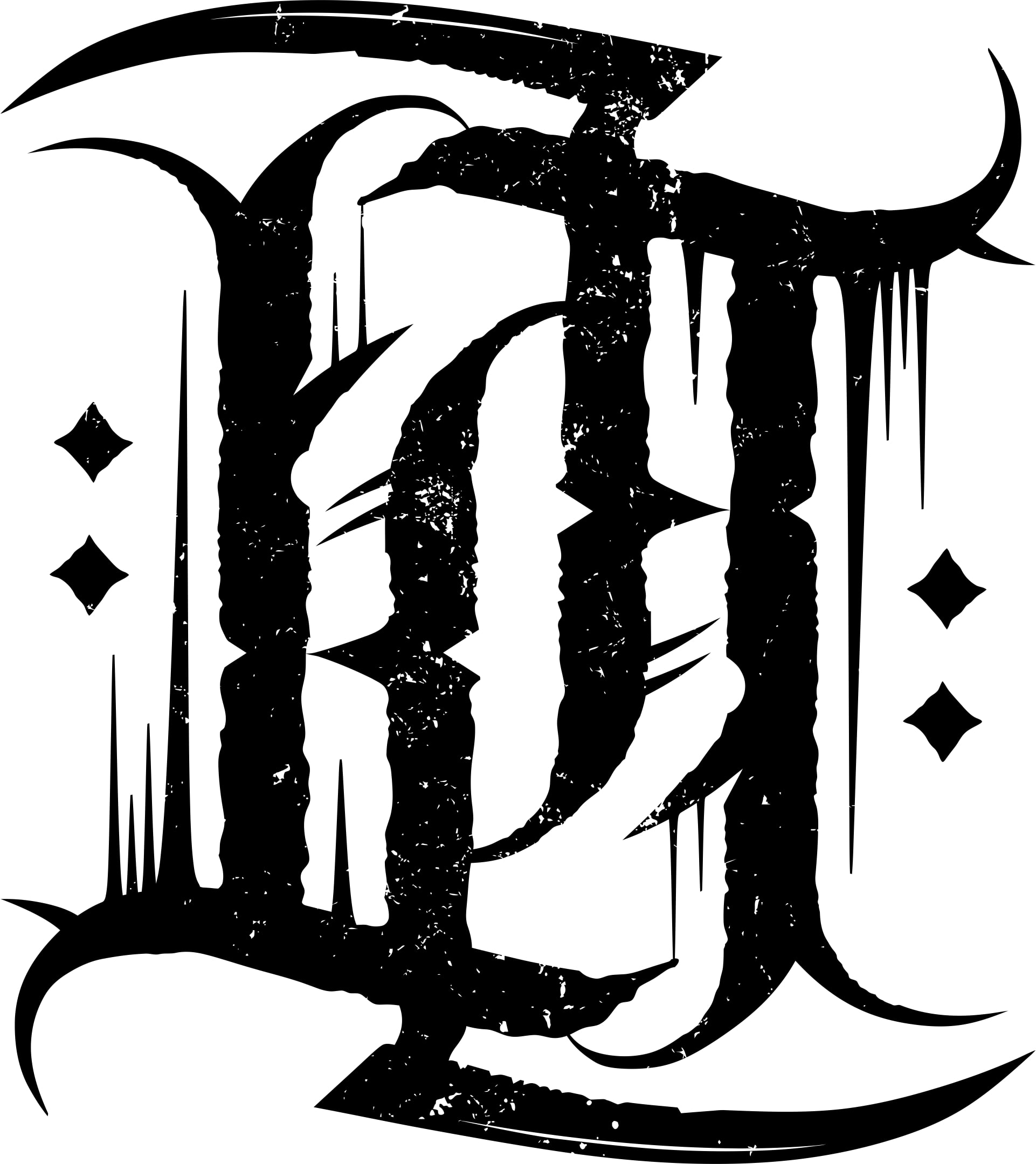
I really like your logo, and also your sigil – its shortened version. Who created these incredibly successful graphic designs? How would you react if some Hekatomb fan (are there any?) got one tattooed on their forearm, for example?
One of us is responsible for the graphics, photos, and logo itself. Ambigram concept The idea for our logo appeared somewhere at the very beginning of our search, when we were already convinced of the band's name. I'm also one of those people who likes this logo, especially since I witnessed its creation. I don't know if I'd be more surprised to learn that we have any fans or that someone would want to tattoo our sigil on themselves. Just as I'm not sure if I'd wish such a person happiness in life or send them to a closed institution for urgent observation.
To make things less rosy, I believe a garden pebble is a medium, specifically a CD-ROM. Why did you decide on this medium? Wouldn't it be better to fork out a little more money or find a publisher who would offer a pressed CD?
We considered pressing CDs, but the main deciding factor was the financial aspect. Back when we were already planning to record and release the material ourselves, we preferred to spend every penny on additional studio equipment, and ultimately chose this recording method. However, it's not certain that future material won't be released on media other than CD-R; time will tell.
Let's dwell for a moment on publishing matters. What prompted you to release your debut material yourself? Were no publishers interested? Or perhaps you decided to have complete control over the entire process, and therefore no one outside your circle was needed?
The idea to record and release everything ourselves emerged quite quickly. Naturally, there are many indications that this material could have been done better, especially since we're still gaining experience in this field. It will likely take a long time (or whatever it is) to reach the level of quality recording studios, but that doesn't bother us. Knowing that we are not dependent on anyone in any way and that we, and only we, have the ultimate influence on everything is much more important than perfect sound or the promotion of the material.
Hekatomb's debut album is characterized by a clear sound, though not without the right amount of grime. Hekatomb Headquaters is your rehearsal space, correct? Did you improvise a studio for the recording sessions, or were the conditions sufficient to record decent-sounding material? Do you rehearse regularly with the full lineup?
Yes, Hekatomb Headquaters is an improvised name for our rehearsal space. With each passing month, we try to adapt its capabilities to create a reasonably decent recording space. We probably still haven't reached a point that would fully satisfy us, but we can see that with each new addition, we're getting better and better. I hope this will be audible in future releases. We meet as a full band relatively rarely, for various, purely mundane reasons. Fortunately, we're able to communicate through various media in the meantime, so we're constantly moving forward, although none of us are seriously considering, for example, playing concerts.
I listen to your debut again and again, and it's hard for me to pinpoint any direct inspirations for Hekatomb, though I can't shake the feeling that I've heard it all before. One thing, however, I'm certain of: the spirit of Mayhem subtly and ethereal hovers over your work. To what extent do you agree with my reasoning? Where else do you find inspiration for your work?
Your interpretation is hardly surprising, as "Crone Time Comes..." was greatly influenced by the music that has filled our heads for almost two decades and from which we couldn't escape while creating the riffs for our demo. Mayhem is one of those bands that most profoundly changed our perspective on extreme forms of music. It's truly difficult to break free from the influence of that Norwegian album. Naturally, Burzum would also be added to the mix, unsurprisingly, but our entire demo naturally bears the shadow cast upon us by the giants of the genre who were working at the time. And while the songs we're currently working on are somewhat more inspired by more recent achievements in this field, I sincerely doubt we'll ever fully free ourselves from that 90s spirit, which isn't something we're striving for anyway.
During the listening session, I was most impressed by the final track, the long, over-nine-minute, slightly trance-inflected "Sacrament Inverted." Is this also a signpost for the direction your work will take? I wouldn't be offended.
From the very beginning, the musical material in Hekatomb has been created by two people, completely independently of each other. We can therefore say with a clear conscience that at least half of the subsequent materials will follow the path set by "Sacrament Inverted." While creating "Crone Time Comes..." we were actually wandering around in the dark, searching for a style and playing techniques that would h we would feel good. Future releases will feature equally long tracks, with much more of that trance style and dense atmosphere. They will certainly be more cohesive than what we presented on the demo.
With "Crone time comes. This life comes to an end," you're taking your listeners on a "disturbing, metaphorical journey into a world of madness, decay, and unholy rituals." How should listeners prepare for it? What should they pay attention to, what should they avoid? Will they return from this journey sane?
I would venture to say that those who willingly embark on such a journey will most likely be largely deprived of their sanity from the start. This is just a joke; extreme metal largely attracts people whose perception of the world differs from that of the average person. In my opinion, black metal in particular is predisposed to offering its audiences a disturbing image—one that differs from the everyday, friendly, and familiar reality of faith, spirituality, or mysticism. I am convinced that our traveling companions will be well-prepared to journey through the visions Hekatomb has prepared for them. The ideal situation would be if our audiences were able to see them as we see them. And what should we avoid? The greatest enemy of this style of writing lyrics and creating music is banality. I sincerely hope there is as little of it as possible, but it's not up to me to judge. !Image
Ritual magic… One of my friends, when asked about this topic, replied that some people need almost theatrical props and a setting to create the right vibrations, others need substances with psychedelic effects, and still others a sharp knife is perfectly sufficient (greetings, S.!). What's it like for you? Are you interested in this topic? Do you have any experiences you'd be willing to share?
I've never practiced magic in any form and don't intend to, so I can't comment on the practical side of it. In my particular case, what's in my head is completely sufficient. However, this doesn't change my opinion of the ritual itself, which I find a very intriguing phenomenon. I'm fascinated by the duality of ritual, its social, consolidative aspect, and the extraordinary intimacy of communing with something larger than oneself. One feels as if one is participating in something simultaneously established, enduring, and ossified (when, for example, dozens of people repeat a specific text, sing songs, or perform the same actions), and fresh and unique (because each mystery has something unique about it). Rituals are and will remain—in their lyrical aspects—a permanent element of Hekatomb's work, that much I can say with complete certainty at this point.
Mother of grief, the Grim Reaper, death. A taboo subject in so-called Western culture (Catholicism, which teaches that man is a unity of soul and body), in contrast to, for example, beliefs cultivated in the eastern part of the globe (e.g., Buddhism, Hinduism). Do any of these concepts of death particularly interest you? A portal to another world, an inevitable end, or perhaps something entirely different? Is there life after death?
One of the most interesting texts in Polish (and indeed secular) medieval literature, "Master Polikarp's Conversation with Death," depicts Death in a way similar to that presented in "Mother of Grief." I'm not referring, of course, to the humor present in the former or to the assessment of contemporary society. I'm referring to bringing us closer to Death itself, not so much to familiarizing it as to understanding it, appreciating it, perhaps even adoring it. In my text, we're dealing with a madman who, for some reason, desires to surrender himself to the maternal embrace of the Grim Reaper, but the motivation for its creation was—I believe—similar. In my view, Death is the ultimate embodiment and quintessence of justice, but it can also be a solace, a cure for suffering, a savior for the tormented soul. I greatly enjoy themes related to the danse macabre, both aesthetically and sociologically, and that's how I'd like to present Death in my writing. The feminine, maternal aspect of the phenomenon in our culture also seems exceptionally interesting to me (although, of course, I realize that among the Anglo-Saxons, Death is masculine, so I don't rule out that subsequent texts on this topic will be written in our native language). However, reincarnation and all its variations in Eastern cultures are completely beyond my comprehension. I don't know if I have a soul, but I'm certain that I have consciousness, which is lost – according to these beliefs – almost one hundred percent when entering a new body. I'm not interested in preserving the former at all costs when passing away. I will go to the other world, but the thought of losing my sense of who I am fills me with fear. I think that's what terrifies us most about dying—along with fear for our loved ones—the feeling that this existence we call our "self" will no longer exist. I would gladly trade entire cycles of reincarnation for an eternity of wandering the world as a disembodied but conscious specter. I should also add that before I gave you the answers to your questions, I received from one of us—one much more versed in Native American tradition than I—a very interesting Slavic interpretation of reincarnation, in which, in my understanding, there is a separation between life, which—by surrendering to death—returns to the eternal cycle of Nature, and the self, which takes its place in the afterlife among our Ancestors and possesses the full characteristics of our personality. As you might guess, this is definitely a more acceptable way of understanding reincarnation. It just so happens that both these concepts—death as a potential beginning of life and the topos of the soul's transmigration—will be strongly emphasized in our next material. Perhaps this is a coincidence.
Regardless of latitude, life's earthly journey ends with burial. As many concepts of death, so many forms of funeral ceremonies exist: from burying a corpse in the ground enclosed in a wooden coffin, through cremation, preserving body parts, to Tibetan sky burials. Where does such ingenuity and diversity in accompanying one's loved ones on their final journey come from? Will this or similar themes reappear in Hekatomb's lyrics in the future? Have you heard the double album "The History of Death & Burial Rituals" by Czech band Death Karma? If so, what are your thoughts on it? Do any of the "exotic" burial methods seem particularly shocking, repulsive, or absurd to you from a European perspective?
Intentional burial of the dead is a characteristic feature of our species (and also of our extinct cousins, the Neanderthals). I don't know of any religion that doesn't address, to a greater or lesser extent, the issue of death and behavior toward the deceased (indeed, even anti-religious Marxism does so, considering the attention paid by its adherents to the Moscow mummy of the prophet of this ideology). However, if I were to hypothesize why we honor our dead in such diverse ways, I would choose anthropological and sociological methodology, not religious, because it is a universal feature of human culture. The simplest explanation would be the exceptionally complex system of human social relations. Unlike the vast majority of the animal kingdom, other humans are not merely reproducing genetic data for us. Our capacious brain is capable of storing hundreds of memories of members of our circle. By caring for the dead, we also ensure that their memory is not erased. We pay tribute to them because, despite their absence in the flesh, they still exist in our memories like living beings. A seemingly forgotten branch of science called memetics possesses a methodological framework that could quite elegantly express my concept, but this is probably not the place for it. My attachment to those who have passed away would explain the importance we place on the dead and their final journey.
Considering the diversity of burials, they are dictated by practical factors. In humid conditions, cremation works much better than burying the remains, which, in turn, undergo natural mummification in arid regions. Observing the diversity and ingenuity of humans in this field is fascinating, especially the ritual customs themselves, which – thanks to their religious element – no longer need to be so pragmatic. Death Karma is a band that is filtering through my speakers as I answer your question, but I admit that this is my first contact with them. For this reason, I can't say anything about the music itself except that I'll give their albums a second and third chance. I think the concept the Czechs have chosen is excellent. Right now, I can say with complete certainty that Hekatomb's next releases will also bear the hallmarks of a concept album, though not in the exact form you're asking about. I believe that creating an entire body of material dedicated to a specific idea is a fantastic form of expression, in all its layers. And while I certainly can't rule out that one day we'll come up with something similar to Death Karma's brilliant idea, the coming years will certainly revolve around slightly different concepts.
Regarding the last point, I certainly won't be original if I draw attention to the Indonesian Toraja people who keep the remains of loved ones in their homes. It's hard for me to say whether this is due to my European roots or simply my sensibilities changing with age, but the sight of a little girl tenderly cradling The (probably) little sister's movement echoed on the inside of my eyelids for quite some time. Of course, I considered writing a few lyrics about it for Hekatomb, but – fortunately or not – we found other concepts in the meantime.
Your lyrics are complemented by ominous, morbid, and highly evocative photographs, which, in my opinion, help capture the message of Hekatomb. Where did the idea for this approach come from? Where did the photoshoot take place and what was it like behind the scenes?
Your assessment is absolutely accurate, because our intention was to create a visual interpretation of the lyrics on "Crone Time Comes..." We found it interesting and, in its own way, added value to the overall presentation. The photographer is the same person who handled the entire graphic design; as I mentioned, it's one of us. Together, we determined how we could illustrate the lyrics on the album. I also had the pleasure of assisting in taking these photos, early in the morning, among the ruins of a pre-war tower located on the outskirts of Szczecin.
Blood, rot, vermin, chalices, and candles... That's been done before, that's out of fashion. Why not booze, vodka bottles, and some piss-filled gate in a shady neighborhood? What are your views on so-called urban black metal? Young people buy it...
Thanks to your question, I learned that there is such a thing as urban black metal; luckily, the rest of the horde is more knowledgeable than me. After learning the names of the genre's representatives, I also learned why I wasn't interested in the phenomenon. I don't intend to dictate the form of expression anyone should take, but in my opinion, there are better forms of metal for presenting this type of aesthetic. Maybe if we played some thrash, we would try something like that, but there's no indication we'll ever start moving in that direction. Black metal has its own specific conventions, governed by its own rules, and—while these rules can certainly be bent or changed within the bounds of common sense—I don't foresee us ever becoming unfashionable. And I won't insult your intelligence by writing what I think about worrying about whether young people buy us.
What's the listener response to your music? I've come across two rather positive reviews online, and that's all. It seems you're not particularly seeking attention, and who's going to hear Hekatomb will anyway, right? How's the album selling? Have you had more pre-orders for your version or downloads from Bandcamp?
Personally, I have to admit that the response has been greater than I expected. It's still miniscule, of course, but it's hard to expect anything from such a niche genre, especially when we're bombarded with new releases every day. We produced just over a hundred albums, sent a few to various record labels, received a lot of help from Paweł from "Widmo zine" (also greetings!), and some of it spread via internet connections. I won't give you the exact numbers, but I think they're similar for both online and physical transfers. Naturally, many people listen to our songs without direct downloads, so it's hard for me to estimate the reach of our demo. We tend to operate under the assumption you mentioned: whoever wants to get to know us will. We're not stupid or arrogant, and we're not expecting a sky-high reach. The fact that we're getting interviews like this one is even somewhat surprising to me. However, I'd be lying if I said I didn't care; it's always good to hear that you've done work that you shouldn't be ashamed of.
Are you already thinking about a follow-up to "Crone Time Comes. This Life Comes to an End"? What can we expect from you? A development of the style we discovered on your debut, or should we expect the unexpected?
I've already mentioned that "Crone Time Comes..." is a somewhat haphazard creation. We tried not to follow any established paths; rather, we threw riffs on tape and saw what would happen. For example, one of the songs on the demo is two songs glued together; the first ones we've ever released. From our perspective, this is a distant memory; we're currently focusing on more coherent material (though still composed by two different people; this difference will be more audible on subsequent albums), both in terms of atmosphere, subject matter, and lyrical content. Another EP, currently tentatively titled "Shade of Life/Light of Death," should be released in the coming months. Further down the line, we'd like to focus on a full-length album. From my perspective, the upcoming material will be significantly more coherent than our debut, but the final judgment will, as always, be left to the readers.
That's all. Thank you for your time. Your final words for the readers