*Heil! You came out of nowhere, only been around for six months (as Metal Archives says), and you can already boast a discography of three albums, including your debut album. Tell our readers about the origins of the band. Were you involved in any musical endeavors before forming Wartödd?
The genesis of the band, not just the band itself, but the project itself is very simple. I recorded the material at home, asked Lesze to contribute his two cents, and that's how a demo was created. As for other bands, we compose a lot, navigating various musical styles.
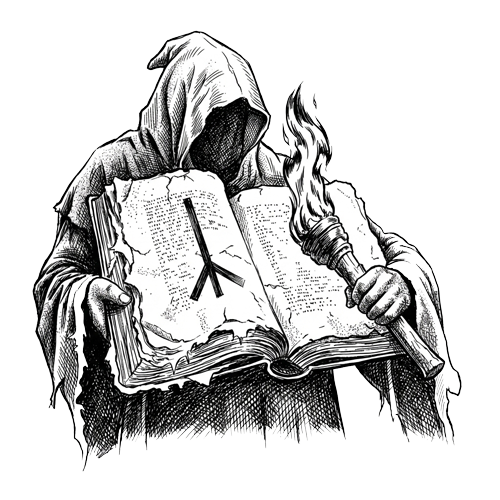
*Your logo (which is also very successful) incorporates a spinning wheel, a variation of the swastika, which is also one of the most common and universal symbols in the world. It appears in almost all latitudes, in various forms and variations, from simple ones consisting of a few lines to complex patterns. It's not easy to determine the origins of the swastika, but it is fairly certain that in primitive societies it was associated with solar cults and symbolized fire and the sun. How do you interpret its meaning? Why did you choose this symbol in the context of Wartödd's work?
The swastika is a beautiful symbol that, above all, symbolizes strength, our roots, and where I come from. In the context of our work, it was used to express our views.
*To what extent do you identify with the faith of your Slavic ancestors? Do you participate in rituals, or would the term "non-practicing believer" be more appropriate? How important are your "spiritual patrons," i.e., Veles and Leshy, to you? Why did you choose these names?
We effectively celebrate Slavic holidays, though not all of them, although mostly in the privacy of our homes. Regarding the pseudonyms, I won't philosophize here – we chose them for the sake of our national faith.
*What does the name Wartödd mean? I've never encountered this word before. Google doesn't yield an answer; is it some kind of neologism?
Wartödd means everything and nothing. I've given listeners free rein to interpret the name.
*You work as a duo. Is this configuration the most optimal for Wartödd? Are you considering expanding the lineup?
We're not considering expanding the lineup; the duo is mobile and comfortable. There's a perfect atmosphere that inspires us to create. This is not the first time we've been working as a duo, and for some genres, it works best. !Image
*What's your creative process like? Do you rehearse regularly or do you exchange files online, and your primary tool is Guitar Pro? How long have you been playing your instruments?
With the flood of musical projects I'm working on, there's no time for regular rehearsals. I record the material at home, send it to Lesze, he listens to it, we exchange feedback on corrections, and he overdubs the drums. We don't use tablature; the material is recorded immediately, and it either fits or it doesn't.
*Wartödd creates raw, pagan black metal of a truly high standard, heavily inspired by the Polish scene of the glorious '90s. What is it that young people like you find so appealing about this format? How did you find yourselves immersed in the Black Metal of almost three decades ago, which at the time was a vehicle for ideas that were dangerous to the masses? Why do you prefer Veles, Infernum, or Fullmoon to Biesy, Odraza, Furia, or another Behemoth?
We play Black Metal because we feel it. What's going on in the Polish scene is a joke. These whole BIESY or GEORGIA bands shouldn't be here. Who let these kids from wealthy families in here?
*An inherent part of the recordings of the old masters of the Polish scene were the unique, spine-chilling keyboard parts, significantly responsible for creating the distinctive and inimitable atmosphere of this music, filling the minds of listeners with visions of cold and death. Wartödd uses traditional instrumentation. A conscious and well-considered decision, or a necessity dictated by personnel shortages?
Regarding the keyboards, this isn't about patching up holes in the missing material. Where we needed them ("Pagan Pride" or the Graveland cover), we added them.
You adhere to the classic Black Metal image, i.e., corpse paint, leather, black, and minimalism. So can you imagine Black Metal without this visual aura? And the actual message, as well as the emotional foundation?
Personally, I don't.
Black Metal in all its glory is meant to represent an experience—catharsis for some, another form of rapture for others. Therefore, we can't imagine Black Metal in any other form than the one in which it emerged during the second wave.
*The lyrics for your debut demo were written in German, while the single and full-length album are written in English.
Where did these changes come from? Are you considering using our native language for future material?
Regarding lyrics, languages are a form of experimentation. I'm experimenting with languages to add some dynamics to our songs. I'm definitely considering recording vocals in our native language, and I can assure all our listeners that we plan to release the material with Polish lyrics.
*Why didn't you decide to print the lyrics in the liner notes for "Pagan Pride"? So, tell us about their subject matter. How much does it align with the keywords published on Metal-Archives, such as war, occultism, Satan, pagan? How would you summarize Wartödd's message?
We didn't print the lyrics in the liner notes for "Pagan Pride," nor will we when our first demo is created on physics. Why? Artists these days too often hand everything to listeners on a silver platter, so I prefer to introduce an element of mystery and that touch of the unknown. It's not up to us to win over the listener, it's up to them to win over us. It's a bold statement, but I think so, and I dismiss the opinions of others as "fairy tales."
*Where did this Satan in the context of Wartödd even come from? At first glance, you don't have much in common with Satanism. Or maybe I'm wrong? *
Satan is how people perceive him. When writing lyrics about pagan gods, who for Catholics are a reflection of Satan, I'm referring to this very universality of the word.
*"Pagan Pride" is the title you gave to your first album. Meanwhile, I wonder if this isn't just pipe dreams and wishful thinking. The faith of our ancestors has been relegated to the margins, pride, honor, courage, and bravery are an increasingly faded memory, and Europe has been gripped by neo-Marxists and blind followers of the false prophet-pedophile under the sign of the crescent moon. Our civilization is on the brink of collapse. Do we have any reason to be proud of this? Do you see a remedy for this situation?*
I think we have reason to be proud of our native faith, hence the title "Pagan Pride." It's 2020, and yet there are many people who still cultivate Paganism. Generally speaking, we engage in music, not politics.
*"The war continues, nothing has changed since the precursor's time." Could you elaborate on the motto you included in the album's booklet? Are you sure nothing has changed? Contemporary Black Metal has been devoured, digested, and spat out by pop culture. It's one of many entertaining and popular genres of music, and has little in common with the ideas that fueled its creators in the 1990s. The percentage of people faithful to its roots is minimal. How do you view this matter?
For whom it was devoured, digested, and spat out, that's why it remained. Our Black Metal is what it once was, and that hasn't changed. Contemporary "Black Metal" often has nothing in common with true Black Metal, so I believe it can't be called that.
*As is common knowledge, Black Metal from the decade that concluded the second millennium was not only music but also a range of activities, at least some of which are covered by specific sections of the penal code. Young fanatics often lived on the edge, and "evil in thought, word, and deed" were not just empty words. Is such an attitude possible in 2020? Is Wartödd "active outside of music"?
Such an attitude is entirely possible. Whether Wartödd is active outside of music is anyone's guess.
*Black Legions, Blazebirth Hall, our own The Temple of Fullmoon. A piece of the lofty history of orthodox, ideologically committed Black Metal. Why do you think such organizations no longer exist, while we have online mutual admiration circles composed of idiots? Would such entities even have a right to exist today?
Of course, they would, with very good organization. The people in those scenes have likely changed, which contributed to the dissolution of such organizations.
*Members of many extreme Black Metal bands active in the 1990s openly proclaimed their support for National Socialism. Today, political correctness and a reluctance to discuss controversial topics reign supreme. Are you interested in political and historical themes? If so, will it be reflected in Wartödd's music and message? So far, I haven't noticed any such signs, but I'm curious what the future holds.*
I think, as above – we are musicians, not politicians.
*On the album, you paid tribute to Graveland by covering the anthem of bygone times, "The Night of Fullmoon." Back in the day, I would have given my arm for Graveland and… I wouldn't have one today. What do you think about the modern face of this band and its leader, Rob Darken, distancing themselves from the past, producing tons of merch, and courting fans of color, following the principle "Everyone who supports Graveland is our supporter?"
A friend?
We don't know Rob Darken personally. Old Graveland is already a classic in the Polish Black Metal scene.
*What is Blackened Force Records? Why does the band need a digital label? Could you explain the process of recording their debut album on Blackened Force Records? *
It's a label owned by our close friends, and we want to help develop it together. We simply agreed to stream it on Bandcamp.
How did you come across Ewiges Eis Records? Were you actively looking for a label, or were you tracked down by German intelligence? How much material is in your contract? Are you satisfied with the support the label provides? Will interested parties be able to purchase your T-shirts or sweatshirts in the future?
Ewiges Eis Records contacted us via email about releasing a full-length album. There's no deal, actually... Jens wrote that he's interested in our next release.
*Prec and his underground band Total War took care of the cassette version of "Pagan Pride"? How did the collaboration with this demon come about? His trust speaks volumes. By the way, are you planning a vinyl version for connoisseurs of the most noble of media?
Prec, like Jens from EE Rec., contacted us via email. Thanks to Fallen Temple, a vinyl version will be released in the coming months.
*When can we expect the follow-up to "Pagan Pride"? Will the style familiar to listeners from the debut be maintained?*
You can expect it in 2021; this year isn't the end of surprises. What will be, will be.
How do you imagine Wartödd in 5, 10, 15 years? What do you want to achieve? What are your plans for the future?
We don't know what will happen in a year, let alone five years... We're just doing our thing now, and what happens after that will happen.
*Concerts. Are they in the cards for Wartödd?*
In due time...
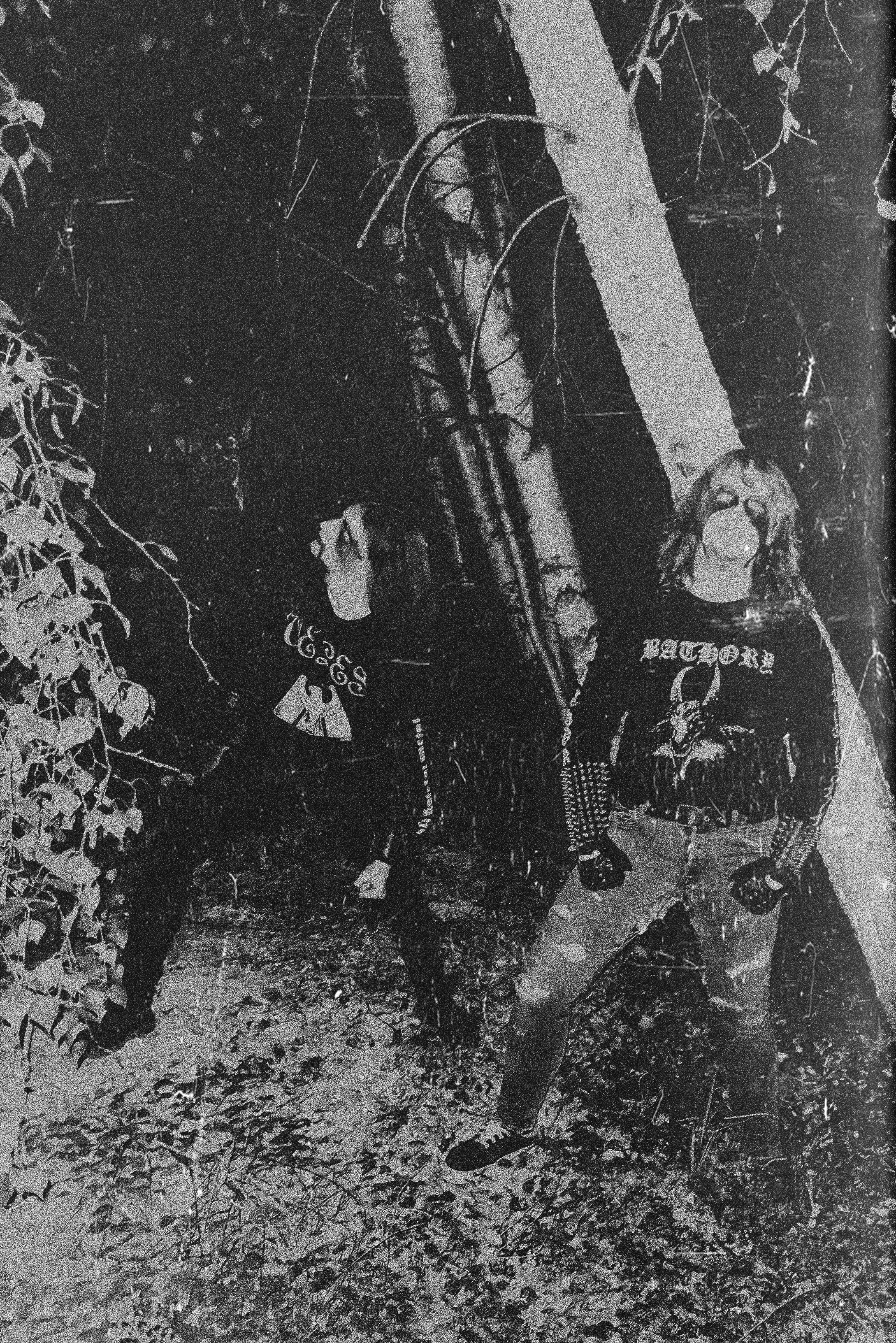
*In the photos, you're wearing Veles, Darkthrone, or Mutiilation shirts, but also Sodom. Veles deserves a big round of applause and a stiff drink for that last shirt, because old, classic metal is essential. What do you listen to on a daily basis, and what sounds—apart from black metal—inspire you? When and under what circumstances did you become interested in metal itself?
Veles: I don't normally listen to Black Metal. I prefer old 80s metal, like Sodom, Necronomicon, Vectom, Sabbat, and Violent Force, but I also listen to a lot of blues and jazz. The foundation of all this, however, is the music of The Doors, J. Hendrix, Wes Montgomery, Led Zeppelin, and Deep Purple.
Leszy: Besides Black Metal, I also like to listen to 80s Heavy Metal, etc. I got into metal as a kid.
*That's all. Thank you for the interview. The last words are yours.
Hails, Infernal Flames!
*This interview was originally published in Cyrograf zine.